


















When I first thought about simple living, I thought it meant owning very little, getting rid of things, or changing my whole lifestyle. I don’t see it that way anymore.
Simple living can be much more practical yet easier. For me, it is about making everyday life easier and removing some of the unwanted things that make a normal day feel more complex than it needs to be.
A simple lifestyle can start with very ordinary things. Maybe there are too many things to clean at your home, too many unwanted notifications on your phone, too many plans filling up your calendar, or subscriptions you keep paying for even though you use them rarely.
In my experience, the changes that helped me most were the ones that were unexpected and I hardly noticed them in my everyday life. Clearing out one kitchen drawer, creating a simple morning routine, turning off notifications I did not need, or becoming more careful about what I agreed to during the week made a real difference. I found that I did not need to change everything at once. Small changes were much easier to keep going with.
There is some research behind this idea too. One study looked at how people experienced their home environment and found a connection between describing the home as cluttered and patterns related to stress. You can read the research on clutter, mood, and cortisol. Research on habits also helps explain why simple routines can become easier over time. Once something becomes familiar, you usually do not have to think about every step as much. See the research on habits in everyday life.
I don’t want simple living to make my life empty. I want fewer unnecessary things taking up my time and attention, so I have more space for the people, activities, and parts of life that actually matter to me.
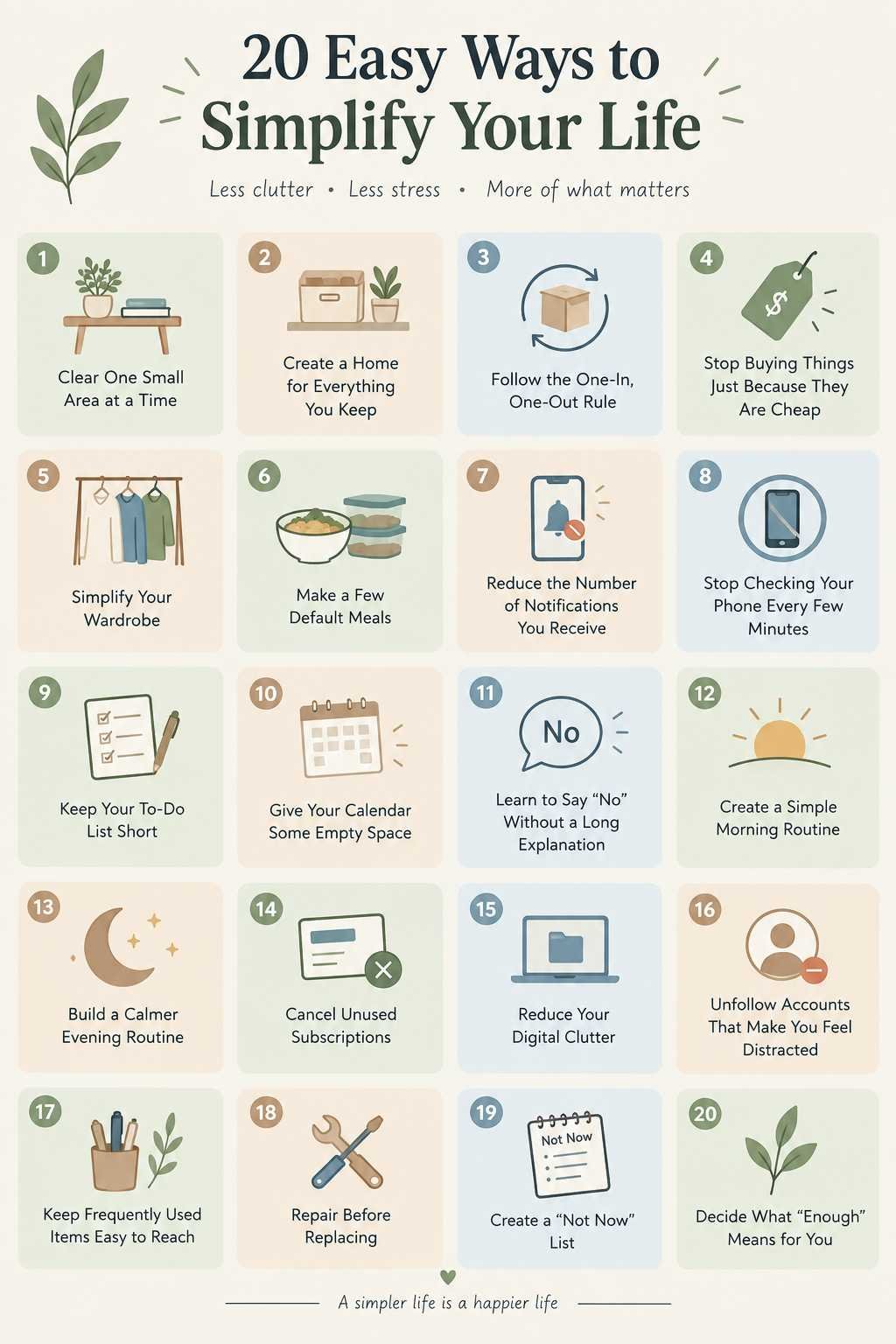
Here are 20 easy ways on how you can start simplifying your life.
1. Clean One Small Area at a Time
Do not begin your journey by trying to declutter your entire house.
Pick one drawer, one shelf, one cupboard, or one corner of a room. Empty it and divide all the items into four groups: keep, relocate, donate, and discard.
I used to make the mistake of taking out an entire cupboard and then got tired halfway through. These days, I pick one shelf and finish that before moving to the next item. This helps in small but immediate results.
There is also some research behind the idea that our surroundings can influence how we feel. A study published in Personality and Social Psychology Bulletin examined home environments and found associations between perceptions of a home as stressful or restorative and patterns of cortisol and mood. The study was conducted with families in the United States and should not be interpreted as proof that decluttering alone improves health, but it does offer a useful reason to pay attention to the environments we live in.
The trick is to start with the place that annoys you most often.
2. Give Everything a Place
Decluttering becomes much easier when the things we keep have a proper place. With kids, I often find toys, books, and little things left in different corners of the house.
Instead of putting everything away myself, I usually ask my husband and kids to return things to where they belong. It took some time for them to get used to it, but now cleaning up feels much easier for all of us .
3. Follow the One Item-In, One Item-Out Rule
Before purchasing something new into your home, ask whether something similar can leave.
Thinking about buying a new shirt? Have a look through your wardrobe first. You might already have something similar you can wear instead.
Getting a new kitchen gadget? Check whether another appliance already does the same job.
Simplicity or simple lifestyle is not about refusing every purchase. It is about preventing possessions from quietly multiplying.
The EPA’s guidance on reducing, reusing, repairing, and recycling household items puts “refuse” and “reduce” before recycling, emphasizing that preventing waste in the first place can be more effective than dealing with it afterward.
4. Stop Buying Things Just Because They Are Cheap
A low price can make something feel harmless and tempting to buy.
But a cheap item still takes up space, can affect your finances, needs a place to be stored, may eventually need regular maintenance and cleaning, and you might ask yourself do I really need it?
Instead of asking yourself, “Can I afford this?”, try asking:
“Would I still want this if it were full price?”
Simple living becomes easier when you buy according to use rather than impulse.
5. Simplify Your Wardrobe
You do not need a small wardrobe to benefit from owning fewer clothes.
Start by identifying the clothes you actually reach for. These are usually your most comfortable, practical, and reliable pieces that you wear everyday.
Put aside anything that no longer fits, feels uncomfortable, needs constant adjustment, or is only being kept because it was an expensive buy and you feel guilty getting rid of it.
A smaller collection of clothes you genuinely like can remove a good amount of daily hassle of decision-making.
6. Make a Few Meals
My most of the discussions with family are around food, everyone has a different choice.
What should I make? Do I have the ingredients? Should I order something? What should I pack for kids lunch?
One simple solution is to create a handful of default meals that you can discuss with you family about the meals. I usually keep a few simple meals in rotation, especially on busy days. For breakfast, I might make something quick like eggs and toast, and for lunch or dinner, I stick to a few meals that I know my family will eat without much fuss.
A simple meal rotation can also make grocery shopping easier because you begin buying ingredients with a purpose instead of filling the cart with random possibilities.
7. Reduce the Number of Notifications You Receive
Your phone can make your day feel busy even when you are not doing anything important. This can easily become part of phone addiction, where checking your screen becomes a habit without you even realizing it.
Every notification gives you another reason to pick up your phone, even when it is not something you need to check right away. I started turning off notifications that are not important and kept only the ones I actually needed, such as calls, messages, and banking alerts.
This practice of turning off notifications made my phone feel much quieter, and I stopped checking it so often just because a notification appeared.
Research discussed by the American Psychological Association’s overview of multitasking and task-switching costs shows that switching between tasks carries a cognitive cost and can reduce efficiency.
8. Stop Checking Your Phone Every Few Minutes
Notifications are only part of the problem. For me, the bigger issue was picking up my phone again and again without having any real reason to check it.
I started keeping my phone away from me while working and stopped carrying it from one room to another. I also made a simple rule for myself: instead of checking messages or social media whenever I felt bored, I would check them at specific times. It was difficult in the beginning, but after a while I noticed that I was reaching for my phone much less often than I did before.
The APA’s research summary on multitasking and switching costs explains why repeated switching can add up over time.
9. Keep Your To-Do List Short
A big task list can create the illusion that everything is equally urgent.
Trust me, It is not.
Try choosing the three to four things that genuinely need your attention, for example:
- Finish the report on time.
- Buy groceries for kids.
- Call the electrician.
A short list also gives you a clear definition of what “done” and what task is pending.
10. Give Yourself Some Free Time
Many people fill every available space in their schedule and then wonder why they feel exhausted all day.
I used to do the same, I was always trying to finish one more task instead of leaving some time for the next day. Once I started keeping a little free time in my day, I noticed that doing nothing for a while actually helped my mind feel a bit calmer. Sometimes I would simply sit with a cup of tea, take a short break, or just do nothing without feeling like I needed to be productive.
An empty hour is not wasted time. Try keeping at least one period during the week with no planned productivity attached to it. Simple living needs some breathing room, and without it, even a small unexpected problem can make the whole day feel exhausting and chaotic.
11. Learn to Say “No” Without a Long Explanation
Every time you say yes to a work, you are also adding one more thing to your day that you have to remember, plan for, or make time for.
That does not mean you should stop helping people or turn down every request. I have simply learned importance of my time more carefully. Just like I think twice before spending money or bringing another item into the house, I try to do the same with my time.
A simple response can be enough:
“Thank you for asking, but I won’t be able to take this on.”
You do not always need a complicated excuse for why you are saying no.
12. Plan a Simple Morning Routine
A complicated morning can make the entire day start with unnecessary mental stress. What should I wear? What should I eat? What do I need to finish before leaving? Making too many small choices can become mentally draining. Research discussed by the American Psychological Association on decision-making and mental fatigue found that making a large number of choices can leave people more fatigued and less productive.
I prefer to keep my mornings simple. I usually prepare what I can the night before, keep breakfast simple, and try to follow roughly the same routine each morning. My routine is not strict, but having fewer things to decide, this makes the morning feel less rushed.
You might prepare your clothes the night before, keep breakfast ingredients together, or leave your work bag by the door. These small preparations can turn a stressful morning into a routine you already know, leaving less mental energy to spend on decisions that do not really need much planning and thinking.
13. Build a Calmer Evening Routine
The same principle discussed above works at night.
Give yourself a basic routine that helps signal that the active part of your day is ending.
Clean the kitchen, prepare for tomorrow, put away obvious clutter, dim the lights, and step away from work.
You do not need a complicated nighttime ritual. Ten or fifteen predictable minutes of preparation can be enough to make tomorrow easier.
14. Cancel Unused Subscriptions
Take a look at your bank and card statements and see how many subscriptions are quietly taking money from you each month. I realized I was paying for a few services that we hardly used, especially some that I had originally signed up for because they seemed useful at the time. The amount for each one was small, but together they were an unnecessary expense.
I started cancelling anything we were not using regularly. With the kids, I also noticed that we did not really need so many entertainment subscriptions. Instead of automatically putting on another show, we started spending more time outside, going for walks, playing, or simply finding something to do away from screens. The American Academy of Pediatrics’ guidance on healthy digital habits for families recommends creating screen-free times and planning regular screen-free activities that families enjoy.
15. Reduce Your Digital Clutter
Your physical home is not the only place that can become crowded.
Look at your computer desktop, downloads folder, email inbox, screenshots, saved posts, browser bookmarks, and photo library.
You do not need to organize thousands of files perfectly.
Start by deleting obvious duplicates and things you clearly no longer need. Create a few broad folders rather than building a complicated filing system.
The best digital organization system is usually the one you will actually maintain.
16. Unfollow Social Accounts That Make You Feel Distracted
Your social media can affect your life more than you can realize.
One day, I noticed that I was spending too much time scrolling social media reels. I would scroll through expensive holidays, perfectly decorated homes, new clothes, and people who always seemed to be doing something exciting. I knew I was only seeing a small part of their lives, but I still was constantly comparing myself.
I started unfollowing accounts that made me compare my life with someone else’s or made me feel like I needed to buy more. I kept accounts that I found useful, creative, or simply fun to follow.
I still use social media, but I am much more careful about what I see every day. Once I reduced the amount of comparison coming into my feed, I found it easier to pay attention to my own life instead of wondering what other people were buying, doing, or achieving.
17. Keep Frequently Used Items Easy to Reach
Pay attention to the things you use every day.
If you use a water bottle constantly, keep it somewhere convenient. If a particular kitchen tool gets used daily, do not bury it behind rarely used equipment.
Storage should support your life instead of forcing you to work around it.
A useful rule is:
The more often you use something, the easier it should be to access.
This also reduces the temptation to leave frequently used items lying around because putting them away is inconvenient.
18. Repair Before Replacing
When something breaks, the automatic reaction is often to buy a new one.
I used to do that too. If something stopped working properly, my first thought was usually that it was time to replace it. But I started changing that habit by checking whether it could be repaired first. Once, one of my children’s clothes had a loose button and I was ready to put it aside, but I simply fixed it instead. It only took a few minutes, and there was no reason to buy something new.
The EPA encourages people to consider repairing and reusing items before throwing them away. Repairing everything is not practical, and sometimes replacement makes more sense. For me, the important part is simply pausing before turning every small problem into another purchase.
19. Create a “Not Now” List
This is one of the simplest ways I have found to deal with new ideas without feeling like I need to act on all of them immediately.
When I get the urge to buy something, start a new project, learn something, or look for the part of the house that needs to be cleaned, I write it down instead of doing it straight away.
Later, I go back to the list and see what still feels worth doing. Some ideas still matter, while others no longer seem important once I have had some time to think about them.
This habit has helped me understand that having an idea does not mean I have to turn it into another task. Sometimes, writing it down is enough for now.
20. Know When You Have Enough
For me, this is one of the most useful parts of simple living. Without knowing what is enough for you, it is easy to keep organizing, buying, adding new goals, and trying to improve everything around you.
I have found it helpful to stop and ask myself whether I really need more clothes, more commitments, more work, more things, or more time on my phone. Sometimes the answer is yes, but often I realize I already have enough and do not need to add something else.
Your idea of enough will be different from mine, and that is perfectly fine. Simple living is not about following someone else’s rules. It is about knowing what works for your life and being comfortable with having enough.
A Simpler Life Starts Small
Simple living does not mean having less for the sake of it. It means keeping the things, habits, and commitments that add value to your life and letting go of some of the rest.
You do not need to change everything at once. Start with one small thing that keeps bothering you and see what happens when you remove it.
Over time, those small changes can give you something more valuable than a perfectly organized home: more time and attention for the life you actually want to live.
References & Sources
- No place like home: Home tours correlate with daily patterns of mood and cortisol — Personality and Social Psychology Bulletin, 2009.
- Multitasking: Switching costs — American Psychological Association.
- About Sleep — Centers for Disease Control and Prevention.
- Getting In and Out of Free Trials, Auto-Renewals, and Negative Option Subscriptions — Federal Trade Commission, Consumer Advice.
- What You Can Do About Climate Change — Waste: Refuse, Reduce, Reuse, Repair, Recycle — U.S. Environmental Protection Agency.