

















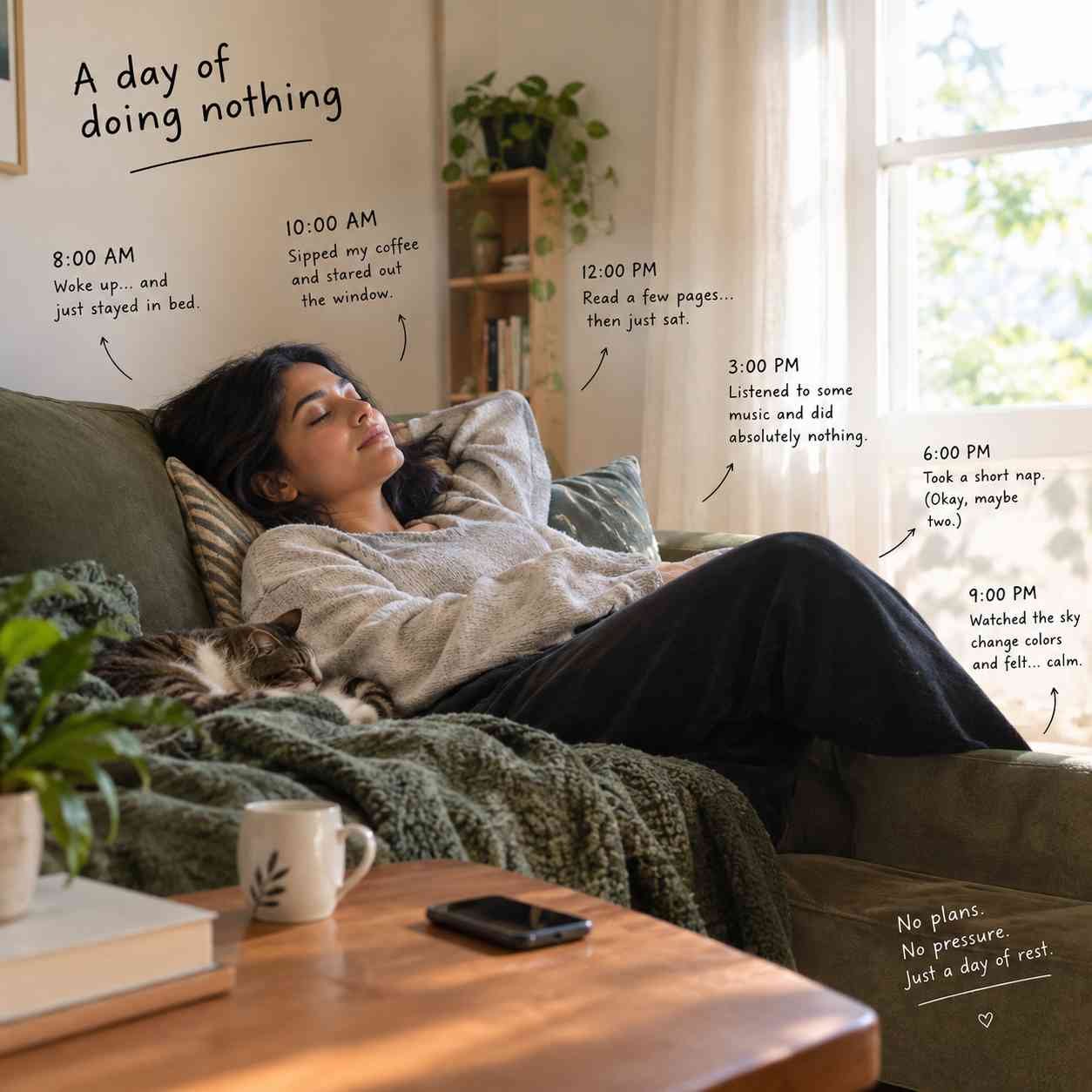
Doing nothing used to feel almost wrong to me. I was so used to keeping myself busy that any quiet moment felt like time I should be using for something else. There was always another task, another message, another small thing to organize or finish. From the outside, I looked productive, but constantly being busy was slowly wearing me down from the inside. I started noticing how rarely I sat without reaching for my phone or finding something to do.
Things began to change when I started simplifying my life and letting go of some of the clutter, commitments, and constant stimulation around me. Minimalist living made me more aware of what actually deserved my time and what did not. One of the simplest changes was allowing myself to do nothing without feeling guilty about it. Sitting with a cup of tea, looking out the window, or just letting my thoughts wander started to feel less like wasted time and more like a way of coming back to myself. I began to realize that doing nothing wasn’t making me less productive. It was helping me feel calmer, clearer, and more present in my everyday life.
What Does “Doing Nothing” Mean?
Doing nothing does not mean endlessly scrolling. Scrolling still gives your brain information to process. True downtime removes demands.
When there is no task asking for attention, the brain does not simply shut down. Research on the brain’s default network and mind-wandering shows that quiet periods can involve internally focused thought, including memories, reflections, and future-oriented thinking.
That helps explain why an answer sometimes appears while washing dishes.
1. It Gives Your Brain a Break from Constant Input
Messages, videos, news, and social media compete for attention.
I noticed this in my own routine when I started taking short breaks without my phone. At first, even ten minutes felt strangely long because I was so used to checking something whenever there was a quiet moment. After a while, those small breaks became easier, and I stopped feeling the need to fill every spare minute with more information.
Try a ten-minute “input break”: no phone, music, reading, or productivity task. The first few attempts may feel boring, but that is part of the process. You are giving your mind a chance to slow down instead of constantly taking in something new.
A systematic review found that short micro-breaks were linked with less fatigue and greater vigor, while effects on overall performance were less consistent. micro-break research on fatigue and well-being
2. It May Help New Information Stick
Rest is not automatically lost learning time. A systematic review covering 37 studies and 63 experiments found that quiet wakeful rest after learning was associated with better memory consolidation. systematic review of wakeful rest and memory consolidation
After a chapter or lesson, spend five to ten minutes doing nothing. Close the book, put your phone away, and let your mind settle before moving on.
This was something I had to learn because I used to jump straight from one task to the next. Once I started simplifying my routine, I began leaving a few quiet minutes between activities. After reading something, I would close the book, sit for a while, and resist the urge to immediately check my phone or start another task. Those small pauses helped me slow down and gave me time to actually think about what I had just read instead of quickly moving on to the next thing.
3. It Can Create Space for Better Ideas
Some problems become harder when you keep forcing an answer. A pause changes the conditions around your thinking.
Research on mind wandering and creative incubation found that mind wandering can have an attention cost while also supporting creative problem solving in certain circumstances.
Not every quiet break creates a great idea. But I have noticed that some of my better blogging ideas have come when I stopped trying so hard to think of them.
When I was working on my blog, I used to sit for long periods trying to come up with new topics or ideas. Sometimes, the more I pushed myself, the more stuck I felt. Once I became more comfortable with simple living and leaving some time unplanned, ideas started coming to me during those quiet moments. I would be sitting with a cup of tea, looking outside, or doing nothing for a few minutes, and suddenly think of a topic I wanted to write about.
That experience made me realize that I do not always need to force an idea. Sometimes it helps to step away and give my mind some room.
Leave a difficult decision or creative problem alone for fifteen minutes. Take a slow walk without audio, sit somewhere quietly, or simply let your thoughts wander. When you return to the problem, you may see an angle you had missed before.
4. It Helps You Notice What You Actually Need
Constant activity makes it easy to react instead of reflect. I noticed this when I finally started leaving some quiet time in my day. Without a list of things to finish or something constantly demanding my attention, I began noticing what I had been missing.
I realized how much I enjoyed simply spending time with my kids without trying to do something else at the same time. I also found myself thinking about an old hobby I had almost forgotten — playing the piano. I had stopped making time for it because there always seemed to be something more important to do.
Those quiet moments helped me understand that some things had disappeared from my life simply because I was always busy. Doing nothing gave me enough space to notice what I genuinely enjoyed and wanted to make time for again.
The goal is not to spend your life idle. It is to create enough quiet to recognize what matters to you.
5. It Can Support Stress Recovery
Doing nothing is not a cure for chronic stress, and it should not replace professional care. Still, fewer demands can create a useful recovery period.
The National Center for Complementary and Integrative Health’s guidance on stress and the relaxation response explains that the relaxation response can slow heart rate, lower blood pressure, and reduce physiological arousal.
Keep it simple. Sit somewhere comfortable, put the phone away, and give yourself ten minutes without trying to solve anything.
How to Start Doing Nothing
Start small enough to repeat.
Try a 10-Minute Empty-Space Habit
Choose one predictable time each day. Leave your phone in another room. Sit by a window or walk without a podcast.
When thoughts appear, let them move without turning them into tasks. When you feel the urge to “make this useful,” simply notice it.
The first few sessions may feel boring. You are learning that empty minutes do not need filling without guilt.
Final Takeaways
Doing nothing taught me that I do not have to fill every minute of my day to make it meaningful. Those quiet moments helped me feel less overwhelmed, spend more time with my kids, return to old hobbies, and even find new ideas for my blog.
You do not need hours of free time. Start with ten quiet minutes a day, put your phone away, and simply be there.
Sometimes, doing less gives you more of what you actually need.
References & Sources
- Wandering minds: The default network and stimulus-independent thought — Science.
- “Give me a break!” A systematic review and meta-analysis on the efficacy of micro-breaks for increasing well-being and performance — PLOS ONE.
- Effects of wakeful rest on memory consolidation: A systematic review and meta-analysis — PubMed.
- Mind wandering simultaneously prolongs reactions and promotes creative incubation — Scientific Reports.
- Stress — National Center for Complementary and Integrative Health (NCCIH).