

















I started thinking seriously about teaching my kids simple living when everyday family life began to feel more complicated than it needed to be. There were toys everywhere, constant requests for new things, screens taking up too much attention, and hardly any quiet time. Like many parents, I found myself dealing with the pressure to keep children entertained while also managing clutter, routines, and a busy schedule.
That made me realize I did not want my kids to grow up believing that happiness comes from having more or always being occupied. I wanted them to enjoy what they already have, handle boredom, care for their belongings, and understand the difference between wants and needs.
Simple living is not about giving children less just for the sake of having less. It is about helping them understand what is useful, what is enough, and what makes family life calmer. I have found that children learn these lessons best through everyday routines rather than lectures about minimalism.
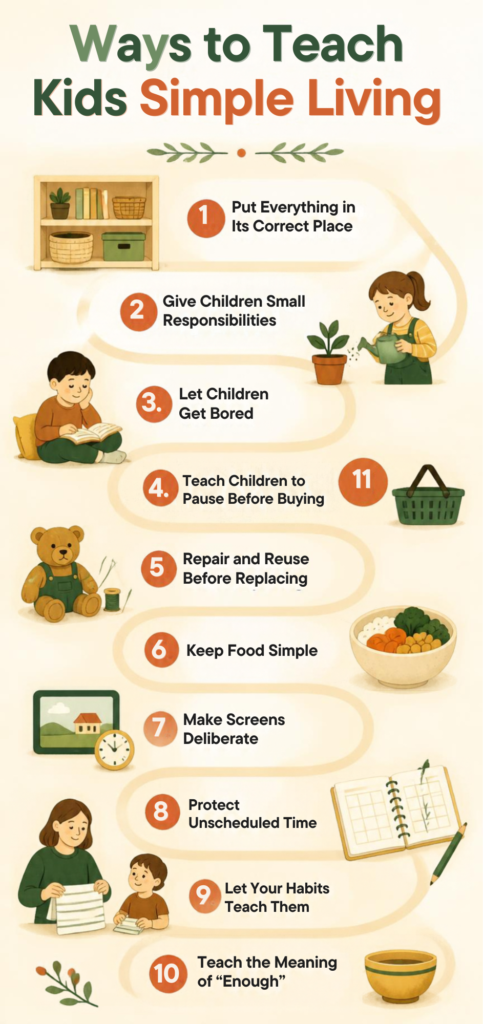
1. Put Everything in Its Correct Place
One of the first habits I introduced with my kids was giving every item a clear place. Earlier, I would often ask them to clean their room, only to find the same toys, books, and clothes scattered around again the next day. I realized that “clean your room” was too vague. So instead, I gave common items their own simple spots—books on one shelf, toys in a basket, shoes in one area, and dirty clothes in the laundry basket.
I also made sure the places were easy for the kids to reach. Rather than expecting them to remember complicated instructions, I repeated the same routine every day: use something, then put it back where it belongs. This small change made tidying much easier and gradually turned it into a habit. The American Academy of Pediatrics also recommends consistent routines and age-appropriate chores such as putting away toys and organizing books.
Instead of saying, “Why is your room so messy?” I now ask, “Where does this belong?” That simple question has made my kids more involved in keeping their own space organized.
2. Give Children Small Responsibilities
Simple living also means understanding that a home is something we care for together.
With my kids, I found that giving them a few small responsibilities worked better than asking them to “clean everything.” I started with simple tasks that were easy to understand and repeat every day.
Here are the four steps I followed to make my kids more responsible:
- Start with one task: I gave each child one simple responsibility, such as putting toys away or placing clothes in the basket.
- Make it part of the routine: We did the task at the same time each day so it became a normal part of daily life.
- Show them first: In the beginning, I did the task with them and showed them where everything belonged.
- Let them take ownership: Once they understood it, I stepped back and let them do it on their own.
A preschooler might put toys away, place clothes in a basket, or help set the table. An older child may pack a school bag or tidy a study area. The CDC recommends letting preschoolers help with simple chores and household tasks. CDC positive parenting tips for preschoolers
The goal is not a spotless house. It is teaching children that daily life includes participation.
3. Let Children Get Bored
A child does not need a planned activity for every empty minute. Give safe, unstructured time with paper, blocks, books, crayons, cardboard boxes, or outdoor space.
UNICEF explains that free play gives children room to use imagination, solve problems, and build independence. UNICEF guidance on free play and child development
I have also learned this from my own experience. Some of the most important moments in my life came during free time, when nobody was telling me what to do. Having that space gave me time to think on my own, discover what I enjoyed, and slowly understand what I wanted to do with my life. I try to give my kids the same kind of space instead of filling every free moment for them.
When a child says, “I’m bored,” resist immediately providing entertainment. Say, “You can choose something to do.” That pause can give children the chance to think, explore their interests, and become more comfortable making their own choices.
4. Teach Children to Pause Before Buying
Children naturally want things they see in shops, videos, or at friends’ homes. Use those moments to teach decision-making instead of automatically saying yes or no.
When I was growing up, my parents were quite strict about buying things. When I asked for something that was not necessary, they would often simply say no. I follow a similar approach with my kids, but I also try to explain why we do not need something.
Ask:
- Do we already have something similar?
- Where would we keep it?
- How often would we use it?
- Do we still want it after a few days?
For nonessential purchases, try a waiting period. Put the item on a “maybe later” list. Often the excitement fades, helping children understand the difference between wanting and needing.
5. Repair and Reuse Before Replacing
When a toy breaks or a shirt loses a button, replacing it immediately can become automatic. Let children see repair as a normal option.
They can help tape a torn book, wash and reuse a container, sort materials for recycling, or turn an old box into a craft project. The EPA recommends refusing unnecessary items, reducing consumption, reusing products, repairing what can be fixed, and recycling when appropriate. EPA guidance on refusing reducing reusing repairing and recycling
Children learn that belongings deserve care and are not always disposable.
6. Keep Food Simple
Food can teach simple living too. Choose a few easy family meals that children know instead of making every dinner a new production.
Let children wash vegetables, stir ingredients, set the table, or pack leftovers. Familiar meals reduce decisions for adults and show children that food is prepared, shared, and appreciated.
A simple dinner together can teach contentment better than an elaborate meal eaten while everyone is distracted.
7. Make Screens Deliberate
Simple living in a digital home does not require banning technology. It means deciding what it is for instead of letting it fill every quiet moment.
Set a few rules the whole family understands: phones away during meals, screen-free time before bed, or unnecessary notifications turned off.
In our home, I follow one simple rule: no phones during meals and no screens for one hour before bedtime. This is easy for my kids to understand because the rule applies to everyone, including me. The American Academy of Pediatrics also recommends screen-free meals and avoiding screens for about an hour before bed.
The American Academy of Pediatrics recommends a family media plan that fits your household’s routines and values and leaves room for sleep, learning, relationships, hobbies, and other activities. AAP Family Media Plan guidance
Parents should follow the same expectations. Children notice adult habits quickly.
8. Protect Unscheduled Time
A simple childhood needs some open space. Not every afternoon has to be filled with classes, outings, appointments, and organized activities.
Protect a small block of unplanned time each week. Children can read, draw, play outside, build, help in the kitchen, or rest.
I have found that having a simple, consistent schedule has also made my kids more disciplined. They know when it is time for schoolwork, play, meals, and bedtime, so they do not have to be reminded constantly. At the same time, I make sure the schedule has some empty space where they can choose what they want to do.
The CDC notes that simple, consistent routines help children know what to expect and can make daily life run more smoothly. CDC guidance on simple routines and predictable family life
9. Let Your Habits Teach Them
Children learn simple living less from instructions and more from what they repeatedly see.
I believe parents are the ones who set the example through their everyday habits. In front of my kids, I try to practice the habits I want them to learn. I pause before buying something, avoid replacing things unnecessarily, put my phone away during family time, and try to enjoy quiet time at home.
If adults shop whenever they are stressed, replace things quickly, complain about having no time, or keep checking phones during conversations, children absorb those patterns. The reverse is true too.
Let them see you finish what you have, repair something instead of immediately replacing it, keep things in their place, or choose a simple evening at home. Your behaviour often teaches more than any rule you explain.
10. Teach the Meaning of “Enough”
Children see constant messages suggesting that the next toy, device, outfit, or experience will make them happier. Home can teach a different message: you can enjoy what you already have.
That does not mean refusing every new thing. Help children notice satisfaction. When they receive something new, encourage them to use it, care for it, and appreciate it before asking what comes next.
Ask, “What do you already have that you love?” or “What was your favorite thing we did this week?” These questions shift attention from getting more to noticing what is already meaningful.
Simple Living Should Feel Like More, Not Less
Teaching kids simple living is not about creating a strict minimalist household. It is about giving children useful skills: caring for belongings, helping at home, enjoying free time, questioning unnecessary purchases, using technology thoughtfully, and appreciating what they already have.
I have found that I also need to notice how the habits I introduce are affecting my kids. A rule may seem helpful to me, but if it is constantly making them frustrated or upset, I do not want to force it just because it is part of our simple-living routine. I try to understand what is bothering them and then make a small change that works better for everyone.
Start with one habit: a toy basket, screen-free dinner, repair project, or quiet afternoon. Let it become normal before adding another. Keep noticing how your children respond, and change the approach when needed.
The goal is not to raise a child who owns the fewest things. It is to raise a child who understands that a good life does not require constant buying, constant entertainment, or constant activity.
Key Takeaways
- Give belongings a home and involve children in caring for them.
- Leave room for free play, boredom, and unplanned family time.
- Pause before purchases and repair or reuse what you already have.
- Keep meals, routines, and screen boundaries simple and consistent.
- Model contentment and help children recognize what “enough” feels like.
References & Sources
- Centers for Disease Control and Prevention — “Positive Parenting Tips: Preschoolers (3–5 years old)”
CDC — Positive Parenting Tips: Preschoolers (3–5 years old) - UNICEF — “What is free play and why should you encourage it at home?”
UNICEF — What is free play and why should you encourage it at home? - U.S. Environmental Protection Agency — “What You Can Do About Climate Change — Waste”
EPA — What You Can Do About Climate Change — Waste - American Academy of Pediatrics / HealthyChildren.org — “How to Make a Family Media Plan”
AAP — How to Make a Family Media Plan - Centers for Disease Control and Prevention — “Tips for Relying on Routines and Rules”
CDC — Tips for Relying on Routines and Rules